Pác Bó, a sacred historical site nestled in the northeastern border region of Vietnam, not far from Bản Giốc Waterfall, is a place every Vietnamese person aspires to visit. This is the first stop, where President Ho Chi Minh chose to live and work after thirty years of tirelessly seeking a path to national salvation. Visiting Pác Bó, travelers not only witness the pristine, rustic beauty of nature but also immerse themselves in a glorious historical space, the birthplace of a great revolution, maintaining its simple charm, much like the life of the beloved leader.
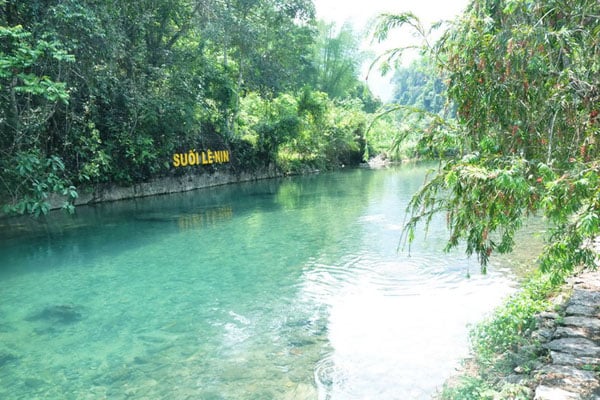
In 1911, Ho Chi Minh left Vietnam, embarking on a monumental journey aboard a French ship to seek a path to national liberation. After years of experience and learning revolutionary methods in Europe, the Soviet Union, and China, he charted a unique course for the Vietnamese people. In 1941, Bác crossed the Vietnam-China border, returned to his homeland, and chose Pác Bó cave as his secret base. Daily, he lived and worked in Cốc Bó cave, naming the stream in front of it Lê Nin Stream and the mountain housing the cave Karl Marx Mountain. For four years, he lived here in secrecy, leading the revolution, and the immense fruit of his labor was the Declaration of Independence, proclaimed at Ba Đình Square on September 2, 1945.
Lê Nin Stream, flowing directly in front of Cốc Bó Cave, appears as a breathtaking emerald silk ribbon. Its water is so crystal clear that one can see to the bottom, where schools of fish swim freely and green moss gently sways with the current. This was where Ho Chi Minh daily came to admire the scenery, compose poetry, and fish, finding peace amidst the arduous revolutionary work. Walking along the rocks bordering the stream, visitors will reach a wooden bridge over Cốc Bó Stream—the source of Lê Nin Stream—and across the bridge is where Bác once sat to cook bamboo shoot soup. The serene, tranquil beauty of Lê Nin Stream leaves every visitor feeling light-hearted and incredibly relaxed.
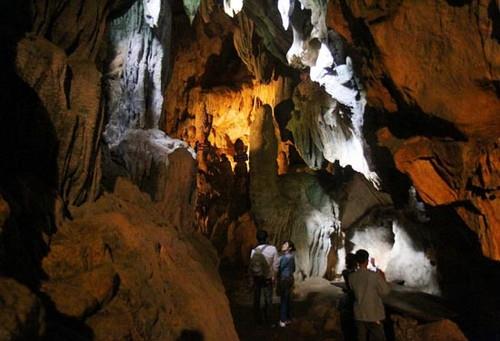
Cốc Bó Cave, covering an area of approximately 80m², is the heart of the historical site. The cave entrance is quite small, allowing only one person to enter, and right at the entrance, there is an inscription "8/2/1941" carved by Ho Chi Minh himself, marking the crucial date of his return to the homeland. Inside, the cave is rather small and humid, hidden deep within the mountain, preserving the simple table and chairs Ho Chi Minh used. Every square meter of the cave tells a story of indomitable will, of the long nights Bác worked, translating party history, and formulating revolutionary strategies, overcoming countless difficulties to regain national independence.
Before entering the main historical area, visitors often stop by the Temple of President Ho Chi Minh to offer incense in remembrance. Ascending a long flight of stairs, one will behold the majestic golden statue of the great leader. Behind the temple is a small museum, solemnly preserving many artifacts and memorabilia of Bác, helping visitors gain a deeper understanding of his life and revolutionary career. This is a place for every Vietnamese person to express profound respect and gratitude for Ho Chi Minh's immense contributions.
Beyond Lê Nin Stream and Cốc Bó Cave, the historical site boasts other equally significant historical points. At the foot of Lèo Tài mountain lies Kim Đồng's Tomb, the resting place of the young hero who sacrificed for the nation, alongside his mother's tomb. Behind the tomb stands a statue of Kim Đồng, accompanied by an artistic wall symbolizing the 14 heroic springs of this national hero. A bit further, Khuối Nặm Hut, built in a stilt-house style, ensured Ho Chi Minh's safety. From the outside, the hut was difficult to detect, but from within, it offered clear views, facilitating observation and retreat when enemies were spotted, along with Khuối Nặm II and Khuối Nặm III huts.
Not just a magnificent historical complex, Pác Bó is also a captivating tourist destination with picturesque natural landscapes. Majestic mountains, gentle rivers, and serene waters blend with the sky, creating a poetic, romantic, and profoundly meaningful tableau. The entire historical area includes prominent landmarks such as Cốc Bó Cave, Karl Marx Mountain, Lê Nin Stream, border marker 108… All converge to form a space that is both solemn and vibrant, where visitors can distinctly feel the interweaving of nature's pristine beauty and the indelible marks of national history.
In Pác Bó, visitors not only admire beautiful scenery and learn about history but also have the opportunity to savor the mountainous specialties of Cao Bằng. Don't forget to try Pác Bó Lam Rice, cooked in young bamboo tubes with highland sticky rice, fragrant with coconut milk, served with sesame salt. Bánh Cuốn Nước Xương is a unique breakfast dish with a filling of meat and egg, served hot with rich, sweet bone broth and pork sausage. Cao Bằng Lạp Xưởng, a specialty of the Tày Nùng ethnic group, is made from firm, flavorful black 'mắn' pork. And Phở Chua, a characteristic dish with various flavors such as crispy fried pork, fried potato shreds, crispy roasted duck, and an elaborately prepared sauce, will captivate any visitor. These dishes not only satisfy the palate but also tell the story of the rich culinary culture of the frontier region.
Pác Bó is more than just a trip; it's a journey to the roots, where every step echoes with history and every glance touches the pristine beauty of nature. Let Pác Bó be a highlight in your exploration of Vietnam, an unforgettable experience of the resilience, patriotism, and majestic beauty of the Vietnamese land and people. Don't miss visiting the Pác Bó Historical Site during your journey to the Northeast mountains!